Ground Resistance
2016
A room-sized installation exposing the limits and frictions of the ‘smart city’
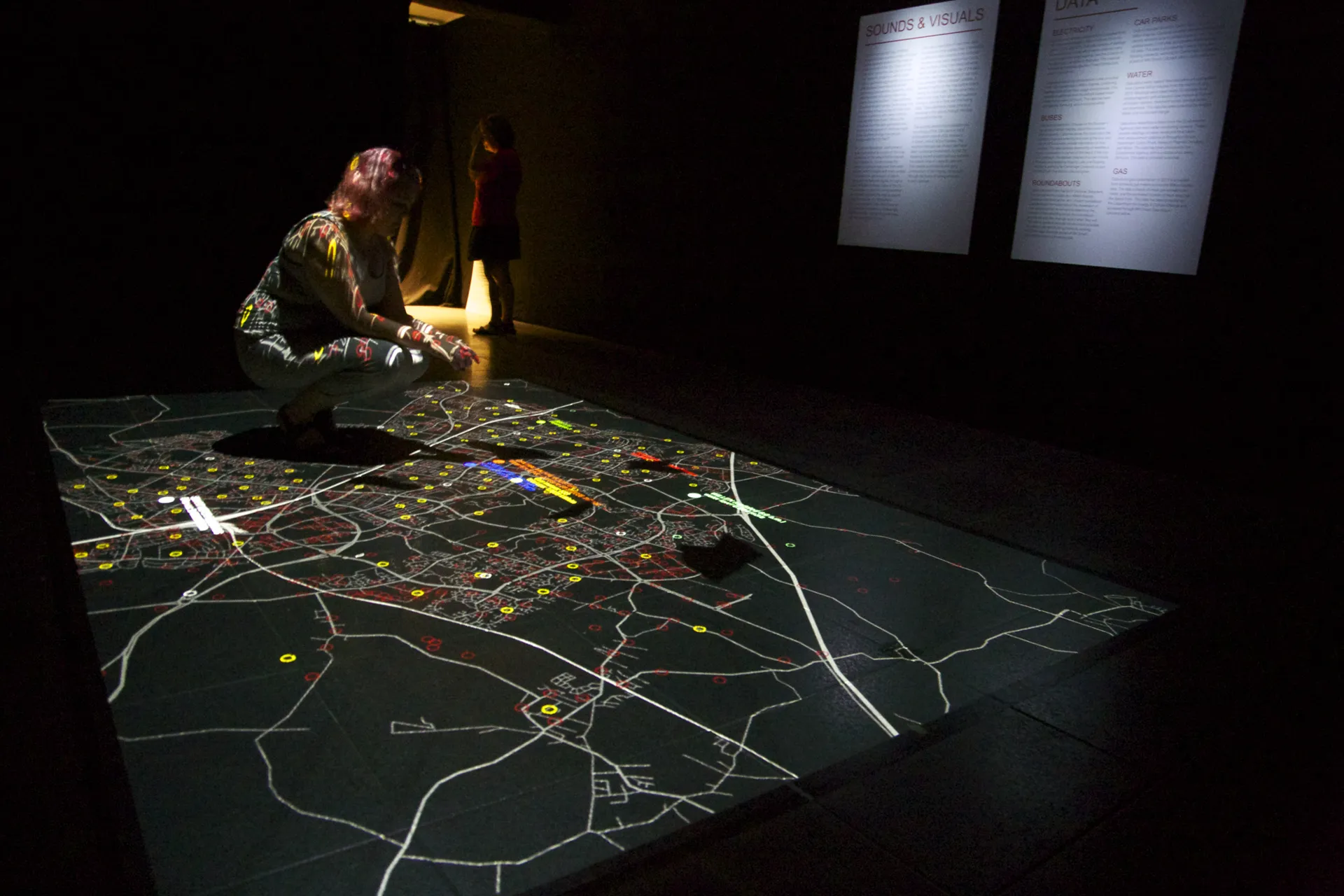
In this installation, the data and sensor streams of a smart city system were re-situated as a walkable, room-sized projection which allowed audiences to see and hear what a ‘smart’ system misses, and who falls between the gaps.
We had been given access to the new MK Smart City system, which brought together sensor data from across Milton Keynes onto a single platform. Ground Resistance inverted the usual aesthetics of the smart city – instead of focusing on the scale and breadth of the data, it focused attention on how slow the data sets updated, and how many only updated once per day despite the ‘always on’ claims of smart city designers.
The installation also drew audience’s attention to where in Milton Keynes there were gaps in the sensor and data coverage: these notably included several low-income housing neighbourhoods, revealing how limited the coverage of the all-seeing smart city can be.
This work was submitted as part of my practice-based PhD thesis Critical Data Aesthetics: Towards a Critically Reflexive Practice of Data Aestheticisation.